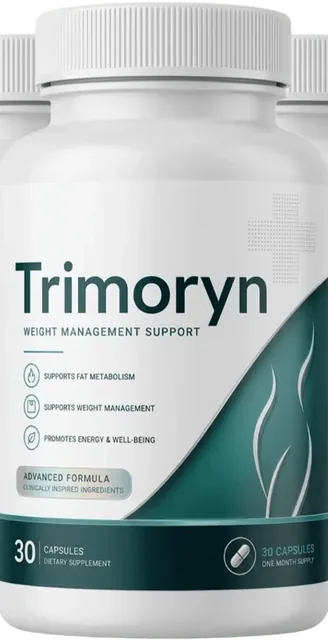
1 bottle
30 capsules in total · 30 days at one capsule daily, the serving the label gives
- One bottle, 30 capsules
- Thirty days at one capsule daily
- The smallest amount of money the 60-day window has to cover
- The pack we recommend for a first purchase

Official product information
Trimoryn is a dietary supplement capsule for weight management and gut wellness.
Use case: Adults who want an easy daily routine take one vegetarian capsule, 15 to 30 minutes before a meal. A 30-capsule bottle lasts a month.
How it works: The panel lists eleven ingredients, including berberine 15 mg, konjac glucomannan fibre, cinnamon bark, alpha lipoic acid and two probiotic strains.
Sold by the Trimoryn retail desk · +1 (323) 391-7425 · read the ten findings on this label.


Trimoryn is a dietary supplement capsule for weight management and gut wellness. One bottle holds 30 capsules, taken one a day, 15 to 30 minutes before a meal. The Supplement Facts panel lists eleven ingredients, including berberine at 15 mg.
Trimoryn is a capsule supplement sold by this retail desk, distributed by Trimoryn, Aurora, CO 80011. One bottle holds thirty capsules, taken one a day, fifteen to thirty minutes before a meal. The Supplement Facts panel itemises eleven rows: riboflavin 25 mg, mangosteen powder 100 mg, prickly pear 4:1 100 mg, cinnamon bark 10:1 100 mg, konjac extract fibre 50 mg standardised to 90% glucomannan, alpha lipoic acid 25 mg, turmeric 15 mg at 95% curcumin, berberine HCl 15 mg, resveratrol 12 mg at 20%, and Bifidobacterium breve and Akkermansia muciniphila at a billion CFU each. The nine weighable rows come to 442 mg. Prices show at the seller’s checkout; the return window is 60 days from purchase.
Start with the good news, because it is real and it is unusual. This is the best-disclosed supplement label this desk has read in eight products. Eleven rows, every one itemised with its own amount. Five of them carry a standardisation figure or an extract ratio — 90% glucomannan on the konjac, 95% curcumin on the turmeric, 20% on the resveratrol, 4:1 on the prickly pear, 10:1 on the cinnamon. A full Other Ingredients line. A vegetarian claim that the capsule material actually supports.
Now the arithmetic that disclosure makes possible. The berberine is 15 mg. NCCIH’s page on berberine and weight loss reports that effects on weight appeared “primarily in people who took berberine in doses of more than 1 gram per day”. And the glucomannan is about 45 mg, where the trials used 1.24 to 3.99 grams — trials which found it “does not have a significant effect on body weight compared to placebo” anyway.
The third thing to know is a mismatch. The panel lists eleven ingredients. The marketing names six — and it does so twice, on two lists that do not agree with each other. Turmeric and resveratrol appear on neither of them.
Our Trimoryn review found ten label points that do not add up. The main ones: the panel lists eleven ingredients while the marketing names six, and berberine is 15 mg against the 1 gram a day that NCCIH links to weight effects.
We read the bottle photographs and the seller pack before writing a word of this site, and checked every ingredient against the NIH Office of Dietary Supplements, NCCIH and Memorial Sloan Kettering. Ten things did not survive that check. A retail site would smooth them over. All ten are printed here instead, numbered, because you are about to swallow this.
The seller pack supplied with this product lists six ingredients: riboflavin, mangosteen, prickly pear, cinnamon bark, konjac and alpha lipoic acid. The marketing image beside this paragraph lists six as well — and four of them are different.
Put the two together and you get nine of the eleven rows. Turmeric and resveratrol appear on neither, which is the odd part: they are two of the five rows the manufacturer took the trouble to standardise.
The heading on that image reads named formula ingredients, which a reader will take as a complete list. It is not one, and the only complete list is the Supplement Facts panel on the back of the bottle.
Nothing except print them. We are a retail desk, not the manufacturer, and we have no explanation to offer beyond what is on the bottle. If any of the ten matters to your decision — and findings 3, 4 and 10 should — the number to call before buying is +1 (323) 391-7425.
The Trimoryn Supplement Facts panel has eleven rows, and one capsule is a serving. Amounts run from riboflavin 25 mg and mangosteen powder 100 mg to berberine HCl 15 mg, with two probiotic strains at 1 billion CFU each.
Every row below is on the bottle. Nothing has been added, reordered or tidied up. Tap any row to see what that ingredient’s research file actually says, with the sentence we quoted from it. The full reading is on the label page.
Tap any row
** Percent Daily Values are based on a 2,000 calorie diet. † Daily Value not established.
Most products this desk has covered used a proprietary blend: one total, no individual figures, nothing to check. Several itemised their amounts. This one goes a step further and standardises.
A standardisation is the number that lets a bottle be compared with a study. “Std. 95% Curcumin” beside 15 mg tells you there are about 14 mg of curcumin in a capsule. “Std. 90% Glucomannan” beside 50 mg tells you there are about 45 mg of glucomannan. Almost nothing in this aisle prints those figures.
Which is why this site can be as specific as it is. Every sum below was done with numbers the manufacturer chose to publish. That is a real editorial decision on their part and it deserves saying before the criticism starts.
Trimoryn contains 15 mg of berberine per capsule. NCCIH says effects on weight were seen mainly at doses above 1 gram a day for more than 8 weeks, so 15 mg is about one sixty-seventh of that amount.
Berberine is the ingredient this category has spent two years talking about, and it is the reason a lot of people will pick this bottle up. NCCIH has published a page on it specifically.
The bars are on a logarithmic scale. The two lower figures are NCCIH’s, not ours: its page on berberine and weight loss reports that “effects on weight were seen primarily in people who took berberine in doses of more than 1 gram per day and for more than 8 weeks”. This label carries 15 mg. The second bar is every weighable row on the panel added together, which is still less than half of the lower figure — and most of that total is mangosteen powder, prickly pear and cinnamon rather than berberine.
“Effects on weight were seen primarily in people who took berberine in doses of more than 1 gram per day and for more than 8 weeks.”
NCCIH — Berberine and Weight Loss: What You Need To Know
Fifteen milligrams is about one sixty-seventh of one gram. Even the whole panel added together — all nine weighable rows, 442 mg, most of which is mangosteen powder, prickly pear and cinnamon — is less than half of the lower figure in that sentence.
It is worth reading the rest of NCCIH’s page too, because it is careful in a way the marketing around this ingredient is not. The 2022 review it cites found decreases in weight and BMI across eighteen studies — and NCCIH immediately adds that “many of the studies included in this review had a high risk of bias, and the outcomes of individual studies were inconsistent”.
It does not mean the product is dangerous, and it does not mean anybody broke a rule. Small amounts of well-known ingredients are legal, common, and in this case printed openly and precisely. What it means is that if you are buying this because of the berberine, the quantity is not there to do what the berberine research describes — and you can establish that yourself in one division, using the manufacturer’s own numbers.
Trimoryn has 50 mg of konjac extract fibre standardised to 90% glucomannan, which is about 45 mg of glucomannan. The NIH records weight trials using 1.24 to 3.99 grams a day, far more than one capsule gives.
Konjac glucomannan is the other ingredient on this panel with a serious weight-management research file. The sum runs the same way, and then it runs one step further.
The Konjac Extract Fiber row is 50 mg standardised to 90% glucomannan, so a serving delivers about 45 mg. The NIH Office of Dietary Supplements records the weight-loss trials as using 1.24 to 3.99 grams a day for up to 12 weeks. The part that decides this section is what those trials found: glucomannan “does not have a significant effect on body weight compared to placebo”. So the amount here is between a twenty-eighth and an eighty-ninth of a dose that did not itself produce a result.
The extra step is the result. On most ingredients in this aisle the honest position is that the amount is too small to say anything. Here the NIH has already said something, at doses twenty-eight to eighty-nine times larger, and what it said was that glucomannan “does not have a significant effect on body weight compared to placebo”.
One point genuinely in the product’s favour, and it is the kind of thing a critical page can be tempted to leave out. The safety concern with glucomannan is oesophageal obstruction from swelling fibre, and the NIH ties the reported cases — seven in Australia in 1984-85 — specifically to tablet forms, noting that “powdered and capsule forms have not been associated with this effect”. This is a capsule, and the amount is tiny. Take it with water anyway; it costs nothing.
Trimoryn lists eleven ingredients: riboflavin, mangosteen powder, prickly pear, cinnamon bark, konjac fibre, alpha lipoic acid, turmeric, berberine HCl, resveratrol and two probiotic strains. Other ingredients are hypromellose, rice flour, silicon dioxide and magnesium stearate.
Tap a card to turn it over and read the sentence we quoted from that ingredient’s source. Two of the eleven have no card to turn, because there is no monograph to quote.
Prickly pear and Akkermansia muciniphila are absent from the cards above for the same reason they are finding 6: we could not find a monograph for either at the NIH Office of Dietary Supplements, at NCCIH, or at Memorial Sloan Kettering. Akkermansia is not mentioned once in the NIH’s probiotics fact sheet, and prickly pear is absent from a NIH weight-loss fact sheet that covers twenty-three other ingredients in detail.
The only percentage on the panel, and it uses an old Daily Value.
Mangosteen PowderGarcinia mangostana, fruit powder100 mgThe biggest botanical row. Its research file is not about weight.
Prickly Pear Extract Powder 4:1Opuntia species, 4:1 extract100 mgNo monograph at any of the three bodies we use.
Cinnamon Bark Extract 10:1Cinnamomum species — the species is not stated100 mgNCCIH: unclear for diabetes or weight loss.
Konjac Extract FiberAmorphophallus konjac — std. 90% glucomannan50 mg (about 45 mg glucomannan)About 45 mg, against 1.24 to 3.99 g in the trials.
Alpha Lipoic Acidthioctic acid25 mgA real file, at a fraction of the studied amount.
Turmeric ExtractCurcuma longa — std. 95% curcumin15 mg (about 14 mg curcumin)About 14 mg of curcumin, and no piperine to absorb it.
Berberine HCLberberine hydrochloride15 mgOne sixty-seventh of the dose NCCIH associates with an effect.
Resveratrol Extractfrom Polygonum cuspidatum — std. 20%12 mg (about 2.4 mg resveratrol)About 2.4 mg, against a gram a day in trials.
Bifidobacterium breve1 billion CFU — strain not named1 billion CFUA real count, at the bottom of the usual range. No strain named.
Akkermansia muciniphila1 billion CFU — strain not named1 billion CFUNot mentioned once in the NIH probiotics fact sheet.
Read all eleven in full, with the exact sentences we quoted from each source and the interaction flags for the four that carry them.
The Trimoryn bottle says adults 18 and over and names no sex. The sales-page title says for women 40+, but the label is not addressed to any age group and is not for pregnant or nursing mothers.
The sales-page title supplied with this product is “Trimoryn | Metabolism Gut Health for Women 40+”. It is the most specific claim anywhere in the pack, because it names a population rather than an effect.
Three things sit awkwardly beside it.
The caution block reads: “Not for use for those under the age of 18 or pregnant or nursing mothers.” That is the only population statement on the label. Nothing on the artwork is addressed to women, to any age group, or to anything to do with perimenopause or menopause.
The eight customers in the pack are Hugh, 49; Marcus, 58; Ted, 41; Omar, 58; Gary, 45; Patrick, 64; Dennis, 60; and Walter, 39. Not one woman appears among them. The same pack supplies three before-and-after photographs, all of women. Neither set is publishable — the pack itself calls its review data layout copy — but the mismatch between the title and the testimonials is a fact about the marketing, not about the customers.
Nothing in the sources this site cites — the NIH riboflavin, probiotics and weight-loss fact sheets, the NCCIH pages on berberine, cinnamon and turmeric, the Memorial Sloan Kettering monographs — reports a result specific to women over forty. If a formula has been designed around the physiology of that group, the design has not been published anywhere this desk could find it.
This matters beyond tidiness. Women over forty are a group with real, specific and frequently dismissed metabolic and hormonal questions, and “formulated for” is a phrase that implies those questions were studied. On the evidence supplied to this desk, the phrase describes a marketing decision rather than a formulation one.
Check six things before buying Trimoryn. The first two matter most: whether you take a medicine that lowers blood sugar, or a blood thinner, an immunosuppressant or a liver-metabolised medicine. If yes, ask your prescriber first.
Answer them and the box at the bottom changes. Nothing is stored, sent or remembered — the verdict is worked out in your browser as you go, and refreshing the page wipes it.
Do you take a medicine that lowers blood sugar, or have diabetes?
Do you take a blood thinner, an immunosuppressant, or a medicine metabolised by the liver?
Are you hoping this will produce the kind of change a before-and-after photograph shows?
Are you pregnant, nursing, or under 18?
Have you spoken to a clinician about what you want to change?
Are you happy to buy one bottle and judge it over thirty days?
Nothing here is stored, sent or remembered. The verdict is worked out in your browser as you go.
The first two questions carry the medical weight, and both are about blood sugar and liver enzymes rather than about weight. The third is about expectation, which on a weight-management product is the variable that decides whether a purchase was worth making.
The live Trimoryn price is shown at the seller checkout. No price list was supplied to this site, so no price is printed here. The calculator below works out the cost per day and per bottle once you enter the checkout figure.
We were not given a price list, so no number on this site is a price. Put the checkout figure into the box and the sums finish themselves — per day, per bottle, and how many capsules the pack actually contains.
At one capsule a day a bottle is thirty days, so a three-pack is ninety and a six-pack is a hundred and eighty. Hold that against the 60-day return window: a single bottle finishes well inside it, a three-pack does not, and a six-pack runs four months past it.
One bottle, one capsule a day. Drag the slider to see where the return window still has you covered.
The pricing page has the full reasoning, and the guarantee page sets out exactly what the 60 days does and does not cover.
Trimoryn is sold in 1, 3 or 6 bottle packs through the seller checkout. A bottle holds 30 capsules at one a day, so the packs last 30, 90 or 180 days. Every pack has a 60-day return window.
Three packs, and no prices printed on this site, because we were not given a price list. What we can tell you is how many capsules each pack holds, how long it lasts at the one-a-day the label gives, and how that sits against the return window.

1 bottle
30 capsules in total · 30 days at one capsule daily, the serving the label gives


3 bottles
90 capsules in total · 90 days at one capsule daily, the serving the label gives


6 bottles
180 capsules in total · 180 days at one capsule daily, the serving the label gives

Every pack: ships from the United States · sealed bottles · 60-day window · returns to 875 Third Avenue, Floor 28, New York, NY 10022, USA · +1 (323) 391-7425
If you are asking which one to buy first: the single bottle. It is the worst value per bottle of the three and we are recommending it anyway. Thirty days is one clean test of a product whose two best-evidenced ingredients are at a fraction of their studied amounts, and one bottle is the smallest amount of money the sixty-day window has to cover. The supplied review copy calls the six-pack the most popular; it is also four months longer than the window.
A two-bottle pack appears in the artwork supplied with this product. No pack list reached this desk, so this site cannot tell you whether it is sold, or at what price. It is on the missing list with everything else we could not establish.
Our own Trimoryn score is 2.7 out of 5. Label transparency scored well, while claim accuracy scored lowest. This site sells the product and earns a commission, so the reasoning is printed beside every row.
This site sells this product and earns a commission on it. A score published from that position is worth exactly as much as its reasoning, so the reasoning is printed beside every row.
Label transparency is a 4, and it is the most deserved 4 in this series. Eleven rows, five standardisations, a full Other Ingredients line and a vegetarian claim the capsule material actually supports. It is not a 5 for two reasons: the only percentage on the panel is computed against a Daily Value the FDA replaced in 2016, and the cinnamon species is not named on a product where coumarin is the relevant question.
Claim accuracy is a 1, and the two scores are connected. A label this precise makes its own claims checkable, and they do not check out: “supports weight management” sits above a glucomannan row at a fraction of a dose the NIH reports as ineffective, and a berberine row at a sixty-seventh of the amount NCCIH ties to an effect. “Clinically inspired ingredients” is the phrase that gives the game away — it is built to resemble “clinically studied” and to assert nothing.
The full verdict page sets out what would change each row, and why there is no star rating and no before-and-after photograph anywhere on this site.
Trimoryn is a capsule supplement named Trimoryn Weight Management Support on the bottle. It holds 30 capsules, taken one a day, and is distributed by Trimoryn, Aurora, CO 80011. This table lists only facts from the bottle and the seller pack.
Everything in this table came from the bottle photographs or the seller pack. Where a fact was not published, the table says so instead of guessing.
| Detail | What we were actually given |
|---|---|
| Product name | Trimoryn, printed on the bottle as Trimoryn — Weight Management Support |
| Claims on the front | Supports Fat Metabolism* · Supports Weight Management* · Promotes Energy & Well-Being* · “Advanced Formula — Clinically Inspired Ingredients” |
| Claims on the sales material | Helps Support Appetite & Craving Control · Supports Gut Wellness |
| Sales-page title supplied | “Trimoryn | Metabolism Gut Health for Women 40+” — see finding 8 |
| Form | Capsules, hypromellose shell |
| Bottle size | 30 capsules — the label calls it “one month supply” |
| Serving size | 1 capsule, 15-30 minutes before a meal |
| Servings per container | 30, so one bottle is thirty days |
| Panel type | Itemised, and unusually well standardised. Eleven rows, five with a standardisation or ratio |
| Ingredients named in the marketing | Six, on two different lists. The panel lists eleven |
| Total weighable actives | 442 mg across nine rows, plus 2 billion CFU across two strains |
| Riboflavin | 25 mg, printed as 1470% where the current Daily Value gives 1,923% |
| Mangosteen powder | 100 mg. No standardisation printed |
| Prickly pear extract | 100 mg, 4:1 — no monograph found at NIH ODS, NCCIH or MSK |
| Cinnamon bark extract | 100 mg, 10:1. Species not named, which matters for coumarin |
| Konjac extract fibre | 50 mg, std. 90% glucomannan — about 45 mg of glucomannan |
| Alpha lipoic acid | 25 mg, against research doses in the hundreds of milligrams |
| Turmeric extract | 15 mg, std. 95% curcumin — about 14 mg of curcumin, and no piperine |
| Berberine HCl | 15 mg, against the 1,000 mg NCCIH ties to an effect on weight |
| Resveratrol extract | 12 mg, std. 20% — about 2.4 mg of resveratrol |
| Probiotics | Bifidobacterium breve and Akkermansia muciniphila, 1 billion CFU each. No strain named |
| Akkermansia status | Not stated whether live or pasteurised — the distinction the human research turns on |
| Other ingredients | Hypromellose (capsule), rice flour, silicon dioxide, magnesium stearate |
| Vegetarian | Yes. Hypromellose is plant-derived, so the vegetarian mark is accurate |
| Allergen statement | None printed. The Other Ingredients line is present, which is what makes the question answerable |
| Label print code | GLP_227_02_061526, on the artwork edge. A production code for the label file — not an ingredient, and not a claim. There is no GLP-1 receptor agonist in this product |
| Who it is for | Adults 18 and over, per the bottle |
| Distributed by | Trimoryn, Aurora, CO 80011 · +1 (323) 391-7425 · [email protected] — no street address |
| Sold on this site by | A licensed u.s. retail desk |
| Price | Price at checkout. The seller pack routes pricing to the checkout |
| Returns | 60 days from purchase, unless the sales page prints a longer window |
| Best before | Not legible on the images supplied |
| Lot / certificate | TRI-26/TR-3966 / TRI-3966-26-TR — both draft references supplied with the pack, not lab proof |
| Customer rating | None published. The pack calls its own review data layout copy |
| Market | United States |
Take one Trimoryn capsule a day, preferably 15 to 30 minutes before a meal. That is the full instruction on the label. It does not say to take it with water, but that is sensible because the capsule contains fibre.
Nine steps, all drawn from the directions on the bottle or from the sources we cite. Where the label is silent — and on one point that matters, it is — this page says so rather than choosing for you.
The label’s whole instruction is: “As a dietary supplement, take 1 capsule daily, preferably 15-30 minutes before a meal.” That is more specific than most supplement directions and it is worth following, because the timing is the part that makes sense for a fibre ingredient.
This is the one addition this desk would make to the directions. The konjac row is a soluble fibre, and fibre capsules are taken with a full glass of water as a matter of course. The amount here is small — about 45 mg — so the risk is correspondingly small, and the habit costs nothing.
This is the step that could matter to your health. Three ingredients on this panel lower blood glucose: berberine, alpha-lipoic acid and cinnamon. Memorial Sloan Kettering warns that alpha-lipoic acid “may be harmful” alongside glucose-lowering drugs, and lists berberine as a do-not-take with sulfonylureas. Nothing on this bottle mentions blood sugar at all.
Resveratrol interacts with warfarin and inhibits CYP3A4, 2D6 and 2C9. Berberine is listed as a do-not-take with bosutinib and with tacrolimus or cyclosporin. The label’s own caution covers this in general terms — “consult with a physician prior to use especially if you are taking a medication” — and that line is doing real work on this formula.
The caution is explicit: “Do not exceed recommended dose.” Doubling would not bring the berberine or the glucomannan anywhere near a studied amount, and it would double the blood-sugar-active ingredients.
“DO NOT USE IF SAFETY SEAL IS DAMAGED OR MISSING.” Straightforward, and worth the two seconds.
The label says to store it in a cool dry place below 30 °C (86 °F). That temperature line matters more than usual here, because two of the eleven rows are live organisms and heat is what kills them.
A window measured from purchase needs a purchase date, and the confirmation email is what proves it. Thirty days of capsules inside a sixty-day window means you can finish a bottle and still be covered.
Thirty days is one bottle and one clean test. Same scale, same time of day, same conditions — body weight swings by a kilogram or two within a day on water alone, and a supplement trial that ignores that measures noise. Write down sleep, alcohol and anything that changed in your eating, because those move the number far more than 442 mg of botanical extract plausibly can.
The full how-to-use page covers a missed day, what to take it with, and why we will not print a week-by-week results chart.
These answers cover what people ask most about Trimoryn: what it is, its ingredients, side effects, price, the guarantee and whether it is FDA approved. Every answer comes from the label and the seller pack.
Trimoryn is a dietary supplement capsule sold for weight management, fat metabolism and gut wellness. A bottle holds 30 capsules, taken one a day, so one bottle lasts 30 days. It is distributed by Trimoryn, Aurora, CO 80011 and sold here by a licensed U.S. retail desk.
Trimoryn lists eleven rows: riboflavin 25 mg, mangosteen powder 100 mg, prickly pear 4:1 100 mg, cinnamon bark 10:1 100 mg, konjac fibre 50 mg, alpha lipoic acid 25 mg, turmeric 15 mg, berberine HCl 15 mg, resveratrol 12 mg, and two probiotic strains at 1 billion CFU each.
The main caution is that berberine, alpha-lipoic acid and cinnamon lower blood sugar, and the bottle does not say so. Anyone on glucose-lowering drugs, blood thinners or other prescriptions should ask their prescriber first. Take the capsule with water because it contains fibre.
No. Trimoryn is sold as a dietary supplement, a category the FDA does not approve. What you can check is the Supplement Facts panel: eleven itemised rows with an amount on each, listed on the bottle and on this site.
Yes, it can. Berberine, alpha-lipoic acid and cinnamon lower blood sugar, and Memorial Sloan Kettering warns about glucose-lowering drugs, immunosuppressants and liver-metabolised medicines. Resveratrol interacts with blood thinners. Check with your prescriber before taking Trimoryn alongside any prescription.
The label says it is not for anyone under 18, or for pregnant or nursing mothers. People on glucose-lowering drugs, blood thinners or immunosuppressants should ask their prescriber before use. Trimoryn is a dietary supplement and not an FDA-approved product.
Yes. Trimoryn has a 60-day return window from purchase, unless the sales page prints a longer one. The buyer pays tracked return postage, and refunds are issued 3 to 5 business days after the return is credited, then 5 to 10 days to reach a card.
Take one capsule a day, preferably 15 to 30 minutes before a meal. This is the exact label instruction, and a bottle of 30 lasts 30 days. The label does not mention water, but taking it with water is sensible because it contains fibre.
The live Trimoryn price is shown at the seller checkout. No price list was supplied to this site, so no figure is printed here. A cost calculator on this page works out the price per day and per bottle once you enter the checkout figure.
Trimoryn is a labelled product distributed by Trimoryn, Aurora, CO 80011, with an eleven-row Supplement Facts panel and a 60-day return window. Berberine sits at 15 mg, well below the 1 gram a day linked to weight effects, so judge it on the label.
This site publishes no rating, no testimonials and no before-and-after photos for Trimoryn, because the ones supplied with the product could not be verified. What you can check is the label: eleven itemised rows, one capsule a day and a 60-day return window.
This site is run by a licensed U.S. retail desk that sells Trimoryn and publishes its full label. The product is distributed by Trimoryn, Aurora, CO 80011. The live price is shown at the seller checkout, and every order carries a 60-day return window.
No coupon or promo code is published by the seller. The pack price shown at the checkout is the price to compare, and each order carries a 60-day return window.
No. The seller lists Trimoryn as a capsule only, 30 capsules to a bottle and one capsule a day, with no drops or gummies listed.
A bottle holds 30 capsules and the direction is one capsule a day, so one bottle lasts 30 days.
Trimoryn comes as a 30-capsule bottle, one capsule a day, with an eleven-row panel and a published 60-day return window. Read the label first, then decide whether it suits you and your medicines.
Thirty capsules, one a day, eleven rows itemised and five of them standardised — the best-disclosed label in this series, and the reason every sum on this site could be done at all. Ten findings printed rather than hidden, and a 60-day return window that is actually published.
60-day window · Questions first? Call +1 (323) 391-7425
Start with the label page for every Trimoryn panel row and the ten findings. The ingredients page covers all eleven rows, and the side effects page explains the blood sugar and medicine notes before you buy.